Well, I'm done with college

And will post many thoughts on that......what I can finally have time to write. But for now, from the road, all I can say is that I miss Williams something awful. It was a wonderful four years, and I was glad to have it.

Booker Speaks at Commencement '11


What a speech.

Carpe Diem

So goes my high school's motto, and I'd like to think that I have. From one reception to another reception to lunch w/ friend to Ivy Exercises to packing to Baccalauriate to party to bonfire to party to packing, it was a full day.

And in 10 hours, I will be a Williams Grad. Wow.

Four Years of Williams E-mails

10177 messages sorted into folders (for committees/clubs) + 18122 messages in my inbox = 28299 total e-mails in.  10902 messages in my sent mail = 10902 messages out

First messages were around July 13, 2007, 1418 days ago. So, on average, I:

Received 19.96 e-mails per day.
Sent 7.69 e-mails / day.

And when you consider that many of those days were weekends/summers/holidays.....wow.

Q_Q

News Desk: Cowboys and Pit Crews : The New Yorker

For one, you must acquire an ability to recognize when you’ve succeeded and when you’ve failed for patients. People in effective systems become interested in data. They put effort and resources into collecting them, refining them, understanding what they say about their performance.

Second, you must grow an ability to devise solutions for the system problems that data and experience uncover. When I was in medical school, for instance, one of the last ways I’d have imagined spending time in my future surgical career would have been working on things like checklists. Robots and surgical techniques, sure. Information technology, maybe. But checklists?

They turn out, however, to be among the basic tools of the quality and productivity revolution in aviation, engineering, construction—in virtually every field combining high risk and complexity. Checklists seem lowly and simplistic, but they help fill in for the gaps in our brains and between our brains. They emphasize group precision in execution. And making them in medicine has forced us to define our key aims for our patients and to say exactly what we will do to achieve them. Making teams successful is more difficult than we knew. Even the simplest checklist forces us to grapple with vulnerabilities like handoffs and checklist overload. But designed well, the results can be extraordinary, allowing us to nearly eliminate many hospital infections, to cut deaths in surgery by as much as half globally, and to slash costs, as well.

Which brings us to the third skill that you must have but haven’t been taught—the ability to implement at scale, the ability to get colleagues along the entire chain of care functioning like pit crews for patients. There is resistance, sometimes vehement resistance, to the efforts that make it possible. Partly, it is because the work is rooted in different values than the ones we’ve had. They include humility, an understanding that no matter who you are, how experienced or smart, you will fail. They include discipline, the belief that standardization, doing certain things the same way every time, can reduce your failures. And they include teamwork, the recognition that others can save you from failure, no matter who they are in the hierarchy.

This is Atul Gawande at Harvard Medical School's Commencement, talking about the work that I'll be trying to enable doctors to do, starting in five weeks!

If, If, If

I watched a bit of the Harvard Class Day events online a few days ago, streaming the speeches as I cleaned up my room and tried to figure out what to save and what to recycle. It's odd, in retrospect, to think about what could have happened if I had chosen to go to a big Ivy League school - my future would likely have been changed, and my networks would have been very different. Unlike so many of my friends here, I had no relationship to Williams, no knowledge of the Berkshires or even of the college's general location - when we first sketched out college locations for a road trip, we put Williams next to Boston.

And yet, I chose Williams, or rather, with its declarations of values, Williams chose me, and my life is changed.

Isn't that remarkable?

So many people in this world have so much of their futures written or swayed by the circumstances of their birth and the demographic trends of the countries they inherit. So many people will never travel across oceans, will never read such ancient works, will never have the chances that I have had and, to some extent, squandered. I know now, looking back, that I could have done much more at Williams - could have written the book I sketched out freshman year about the desires and beliefs of the "Obama Generation," could have spent an aggregated 20 hours more editing all of my essays (with a probable .1 GPA bump), could have, could have, could have.

But I'm happy with what I did here, and more importantly, with what I learned here. Williams taught me a huge number of incalculable things, many of which are hard to articulate, but I know that I'll be more effective and harder working at all of my future jobs because of it. I could have gone to another school, yes (assuming my admissions to Williams wasn't a lucky fluke), but I'm well-situated now to have the life that I want - to enjoy my work, to have enough income to live securely, and ultimately to become one of the many citizens that makes this country work.

Leaving my deck

Susie Hopkins House, my incredibly lucky residence, has two upstairs rooms that share access to a private deck (the rest of the house can go through a window as well). I'm feeling a lot of conflicting emotions today, as I begin to walk towards the end of my time at Williams in the form of one more final exam, but my deck is a constant; where the weather is great and the view of trees and grass wonderful (if atypical).

But, given the recent failed rapture, I do feel ironically left behind, in a sense. My deck is only wonderful when I share it with the people I love, whether in rocking under an umbrella while singing, holding each other in the rain, or having one of those long conversations that mark true and lasting friendships. I'm never going to pay so little for such a palatial living situation; I couldn't have asked for a better place to end my time at Williams than Susie Hopkins, alongside my wonderful housemates Chris, Asad, Ayyaz, Ville, Mike, Diego, Rosie, and Will.

But I do have to come inside from the deck, and I do have to get food and take this test. I do need to leave this campus, and take my place in the wider world, whatever that will be. People have told me recently that I'll be fine, or that they expect me to accomplish great things, but I know this: luck, as Randy Pausch said, is preparation times opportunity, and I may well be "unaccomplished" in my life. I might not hold the titles and the offices that others have jokingly and non-jokingly attached to me; all I hope is to have enough to live securely, and to hold the titles of husband and father. It may well happen that more opportunities present themselves, and I will take them, but I will not scheme or devise a master plan to lead to any outcome.

My plan, instead, is to do what feels right, and to make decisions day-to-day that I can live with for the rest of my life. If my time at Williams and before is any indication, that may well be enough, and I have to live with both that possibility and the chance that it won't come to any fruition. But as I ended my last record op-ed: I may never uphold my values perfectly, but there are angels in history and the present time to guide me on my way.

Shoutout

I decided, with caution, to take CSCI 134 this semester. It has been a blast, much thanks to my two wonderful professors. Not taking CS earlier is certainly one of my greatest academic regrets from Williams.

Cascades

This is the "inside" film of Cascades, my favorite bell composition. Sorry about the difficulty of hearing the song; that's how it is inside the room. I think this is a better example of the ringing process than the actual sound. My entire recital is here and here.

Epic - Where I'll be working


Next year, I'll be joining a few other Ephs at Epic, an awesome company located in Madison, WI. I'll admit that when I initially applied, I thought of Epic as a long-shot - I didn't know if the position I was applying for was a good fit, and Wisconsin didn't even border any states I had visited. After this, though, came a whole series of interesting and fascinating screening methods, all of which I'm afraid I'm already too loyal to reveal. :P


What I will say, though, is that the screening process was smart enough for Epic to figure out that I had applied for the wrong job. And so, when I received an offer to fly out to Wisconsin, it was for a different gig - one that was much more exciting, and much better fitting my interests and aptitudes. But still - Wisconsin? My skepticism changed with two events.

First, my friend A, another Project Manager to-be, sold me on the company. That's a nice story by itself (I'll be going there with at least two other '11 Ephs, not to mention other Williams grads already employed), but consider the time: 2 am. And the place: a rugby pitch.

You see, A and myself were both volunteering for a 24-hour Rugby match for charity, happening between 8 am Saturday the 23rd of April and 8 am on Sunday the 24th, which also happened to be Easter. And so, after my midnight Easter vigil, I came down to the field. Drei asked about my employment situation, and I told him I was flying to this "Epic" company in Madison, not remembering that Andrei was from Madison, or that he would be working at Epic.

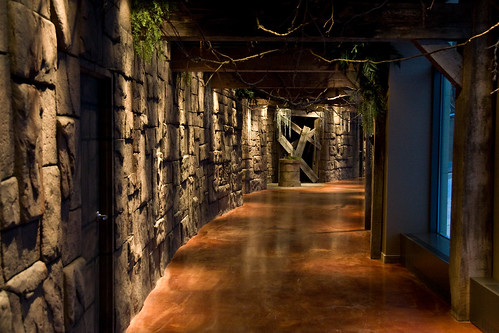
And so, standing by the pitch, as the players took a sanctioned break, I was sold on the company I hadn't visited yet. Flying there confirmed everything that Andrei had told me: Epic is an open company: the middle picture on the left shows the giant assembly hall where they hold a monthly all-company meeting where honesty and transparency are the name of the game. Their cafeteria uses a ton of natural light, and their corridors was wonderfully designed, as is their landscaping. The campus is gorgeous, no one has a cubicle, and in the winter, you can take underground tunnels between all of the buildings.

Most importantly, though, are Epic core values. I can't find them online anywhere, but here's a teaser:  Epic has a treehouse, recycles 65% of construction waste (and there is always construction thanks to the explosive growth), has a working farm with cows, uses a geothermal system to heat/cool the buildings, offers many neat benefits, and most importantly, holds confidentiality sacrosanct, even as the company allowed me, a recruit, to wonder around the various buildings to see for myself that the entire place was as neat as the smidgen I had seen on my tour.

What will I be doing? Essentially, I'll be making Epic's software work, which is precisely in line with what I hope to do with the rest of my life - to enable better processes to serve more people at lower cost. Epic is a fantastic place to start that journey, and I'm looking forwards to my time there.

Good Day

Life is good.

My Senior Recital

Student Recitals.jpg
(text courtesy of the Williams Dept. of Music)


Program

The Williams College Department of Music will present a senior recital featuring William Slack on Thursday, May 12 at 4 p.m. in Thompson Memorial Chapel on the Williams College campus. This free event is open to the public.
Slack will be playing the Thompson Memorial Chapel Chime and the audience can enjoy it anywhere on campus where they can hear them. He will play pieces by George Alfred Grant-Shaefer, George Harrison, Howard Shore, Robert Wadsworth Lowry, Talcott Banks, and Richard Rodgers as well as some of his own original compositions.

About the Carillonneur:
William Slack ’11, of Decatur, Georgia, began ringing in 2007. He has performed and arranged numerous songs for the bells, from hymns to pop music, in addition to original compositions. Will also plays the piano, trombone, and djimbe, and has sung with the Williams Chamber and Concert Choirs under Brad Wells.

About the Chime:
Installed in the autumn of 1904, the Thompson Memorial Chapel Chime consists of 10 bells tuned in an Eb Major scale with an additional ninth and a flat seventh, accommodating music in the keys of Eb Major, Ab Major, and F Minor. The Chime is played via a console of levers that are directly attached via lengthy wires to heavy clappers, which the Carillonneur pulls into the bells with varying intensity, depending on the desired dynamic.