How one man escaped from a North Korean prison camp | Books | The Guardian

How one man escaped from a North Korean prison camp | Books | The Guardian: Shin was assigned the pig farm where he snacked on corn, cabbage and other vegetables, and sometimes even sneaked an afternoon nap. Turning 20 on the farm, Shin believed he had found the place where he would grow old and die. But in March 2003 he was transferred to the camp's garment factory where 1,000 women stitched military uniforms during 12-hour shifts. When their foot-powered sewing machines broke down, Shin fixed them.

In the summer of 2004, while he was carrying one of these cast-iron machines, it slipped and broke beyond repair. Sewing machines were considered more valuable than prisoners: the chief foreman grabbed Shin's right hand and hacked off his middle finger just above the first knuckle.

Should there be an obese surcharge?

"Weigh More, Pay More" by Peter Singer | Project Syndicate: CommentsView comment on this paragraphFriends with whom I discuss this proposal often say that many obese people cannot help being overweight – they just have a different metabolism from the rest of us. But the point of a surcharge for extra weight is not to punish a sin, whether it is levied on baggage or on bodies. It is a way of recouping from you the true cost of flying you to your destination, rather than imposing it on your fellow passengers. Flying is different from, say, health care. It is not a human right.

An increase in the use of jet fuel is not just a matter of financial cost; it also implies an environmental cost, as higher greenhouse-gas emissions exacerbate global warming. It is a minor example of how the size of our fellow-citizens affects us all. When people get larger and heavier, fewer of them fit onto a bus or train, which increases the costs of public transport. Hospitals now must order stronger beds and operating tables, build extra-large toilets, and even install extra-large refrigerators in their morgues – all adding to their costs.

The Sad and Infuriating Mike Daisey Case

1) Daisey's downfall is the sadder and more infuriating because it was so completely unnecessary and avoidable. If he had even once said that he was presenting a polemic, a metaphor, a dramatization, an "inspired by real events" monologue rather than real "facts," no one could ever have complained. Do we care whether Harriet Beecher Stowe ever saw runaway slaves jumping on ice floes as they fled across a river? (Stowe described Uncle Tom's Cabin as a "series of sketches" conveying the cruelty of slavery.) Do we care whether Upton Sinclair had actually seen the packinghouse cruelties he described in The Jungle?  Whether any family exactly like the Joads was known to John Steinbeck -- or exactly like George Bailey's or Mr. Potter to Frank Capra for It's a Wonderful Life? Charles Dickens and Oliver Twist? You get the point. Mike Daisey could have had 98% of the intellectual/social impact of his monologue, and zero % of the dishonesty and now disgrace, if he had described it as an attempt to convey the truth of a situation through imagined details.

2) Daisey's lying will hurt the Western press and international worker-rights groups.  When they get all huffy, Chinese nationalists love to present the Western press as being irremediably biased against Chinese achievements and ambitions, and willing to pass along the most outrageous slanders about China without checking them for accuracy or even plausibility. A site called Anti-CNN is a well-known outlet for such views. This is a constant nuisance when you try to write critical assessments. Worse, it gives ammo to those inside China who want to pooh-pooh complaints about safety, pollution, working conditions, and so on. Daisey is everything they warned against, come to life.

h/t AWC

Currently Gawking:
Since we didn’t see much of the white stuff this winter, I”ll have to be satisfied by these astounding patterns created by Simon Beck. The man hikes around in snow shoes with a GPS and creates this kind of magic. Pretty incredible. Okay, fine, REALLY incredible.


LINK: Simon Beck

FYI

I had the pleasure of making someone's acquaintance tonight, along with a long and lovely conversation on advice for the future and text messages to a nephew. But in order to avoid some drama, I didn't have the chance to say a proper goodbye when the bar closed up, and I regret that I only waved (and think you didn't see it). So if you're out there: fare well, my friend. :)

(Debuting a new "Craigslist" label for posts like these)

All the shengnu ladies - Salon.com

All the shengnu ladies - Salon.com: Where are the 30 million surplus men?

Where are the 30 million surplus men?
In the countryside, tending to their parents and their farms. Because in Chinese society, it’s expected women will marry up, that’s exactly what most women in rural areas do. They migrate to bigger cities, find better jobs, marry men in higher classes, and in some cases, even end up providing more money for their parents than the males who remain on the farms taking care of them. In a fascinating piece for the Pulitzer Center, journalists Sushma Subramanian and Deborah Jian Lee report that these women are known as “golden turtles” for the wealth they are able to provide for their families by migrating and marrying up. Their “success” has given pause to China’s traditional preference for sons, all while leaving thousands of men behind in perpetual bachelorhood. These men, also known as “guan gun” or “bare branches,” are at the rock bottom of the marriage chain, and although equally strapped for an available pool of partners to choose from, are not very compatible with the average shengnu, socially, intellectually or geographically.

I believe it

Cyberloaf Monday:
Since people tend to surf the web more when they're tired, today is especially unproductive:
The investigators [led by David Wagner] recognised an event that affects everyone’s sleep: when the clocks go forward for Daylight Saving Time. Prior evidence suggests we lose on average 40 minutes of sleep per night following the switch, as our body rhythms struggle to adjust. ... [Wagner's team] found that Entertainment-related searches on the Monday after DST were 3.1% more prevalent than the previous Monday, and 6.4% than the subsequent Monday.

On Exponential Growth

fanaticflyer comments on Forgive me, but is the Singularity an event, or a process?: 
"Imagine a magic pipette. It is magic because every drop of water that comes out of it will double in size every minute. So the first minute there is one drop, the second minute there are two drops, the third minute four drops, the fourth minute eight drops and so on… This is an example of exponential growth. Now, imagine a normal sized football stadium. In this stadium you are sitting on the seat at the very top of the stadium, with the best overview of the whole stadium. To make things more interesting, imagine the stadium is completely water-tight and that you cannot move from your seat. The first drop from the magic pipette is dropped right in the middle of the field, at 12pm. Here’s the question: Remembering that this drop grows exponentially by doubling in size every minute, how much time do you have to free yourself from the seat and leave the stadium before the water reaches your seat at the very top? Think about it for a moment. Is it hours, days, weeks, months? The answer: You have exactly until 12:49pm. It takes this tiny magic drop less than 50 minutes to fill a whole football stadium with water. This is impressive! But it gets better: At what time do you think the football stadium is still 93% empty? Take a guess. The answer: At 12:45pm. So, you sit and watch the drop growing, and after 45 minutes all you see is the playing field covered with water. And then, within four more minutes, the water fills the whole stadium. This means that you think you are safe because it seems that you have plenty of time left, whereas due to the exponential growth you really have to take immediate action if you want to have any chance of getting out of this situation."

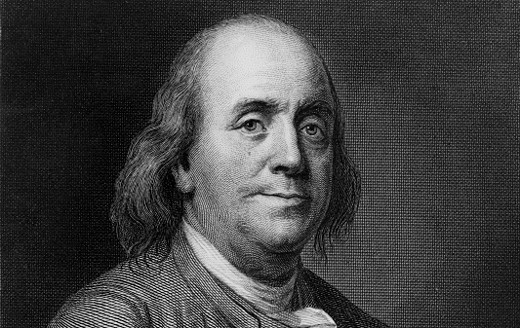
Franklin's 13 Virtues

Franklin's 13 Virtues:
 
(Source: The Autobiography of Benjamin Franklin; Image: Benjamin Franklin, via.)

In 1726, at the age of 20, Benjamin Franklin devised a list of 13 virtues to live by for as long as possible, in an attempt to "live without committing any fault at any time." He then focussed on one virtue each week and kept notes on his progress. He began with "Temperance."

The list read as follows (click through to read)

So I watched some Downton Abbey this weekend...

A few observations:
  • I'm a complete sucker for truly good or truly evil characters - think Abigail Williams from The Crucible or Achilles from Orson Scott Card's "Ender" or "Bean" series's on the bad side. Anna, pictured at right, is one of the good ones - she doesn't take a single false or bad step over the hours and hours of the two seasons, which makes her incredibly unrealistic and yet compelling as we root for her and her Jane Austen beau. That screencap is from 11:11 in the first episode, but its context makes it obvious that she's the "good gal" and probably his romantic interest. Unrelatedly, I can't imagine how boring it must be to be an actor that never changes one's costume, with probable corsets to boot.
  • I also didn't realize how much of a structure the "downstairs" staff of a great house had. For example, a housekeeper (head of women service) had the title of "Mrs," and the Butler presided over a formal servant's dinner, complete with all staff rising upon his entrance to a room. Those positions were true pinnacles, albeit within a small universe of long hours and bowing/scraping to unworthier guests.
  • The show is a mixture of fairly typical television plotlines ("Father, I'm political!") made more interesting by strong characters and writing, espeically the vicious and amazing one-liners of Maggie Smith's character, who becomes much more decent throughout the series. Acting is also excellent, but I worry that cheap emotional hooks won't hold viewers without more interesting plotlines in Series Three.

If You're Bluffing, It's Best to Avoid the Question - Clive Crook - International - The Atlantic

If You're Bluffing, It's Best to Avoid the Question - Clive Crook - International - The Atlantic:

Fallows recommends this article by Paul Pillar, We Can Live with a Nuclear Iran.

[W]e find ourselves at a strange pass. Those in the United States who genuinely yearn for war are still a neoconservative minority. But the danger that war might break out--and that the hawks will get their way--has nonetheless become substantial. The U.S. has just withdrawn the last troops from one Middle Eastern country where it fought a highly costly war of choice with a rationale involving weapons of mass destruction. Now we find ourselves on the precipice of yet another such war--almost purely because the acceptable range of opinion on Iran has narrowed and ossified around the "sensible" idea that all options must be pursued to prevent the country from acquiring nuclear weapons.

Given the momentousness of such an endeavor and how much prominence the Iranian nuclear issue has been given, one might think that talk about exercising the military option would be backed up by extensive analysis of the threat in question and the different ways of responding to it. But it isn't. Strip away the bellicosity and political rhetoric, and what one finds is not rigorous analysis but a mixture of fear, fanciful speculation, and crude stereotyping. There are indeed good reasons to oppose Iranian acquisition of nuclear weapons, and likewise many steps the United States and the international community can and should take to try to avoid that eventuality. But an Iran with a bomb would not be anywhere near as dangerous as most people assume, and a war to try to stop it from acquiring one would be less successful, and far more costly, than most people imagine.

Obama either agrees with this analysis or he doesn't. If he agrees with it, of course, you wouldn't expect him to say so, because that would take the pressure off Iran's government. But you also wouldn't expect him to say, as he now has, that if US military action is what it takes in the end to stop Iran then so be it. If on the other hand Obama disagrees with Pillar's analysis--which is what he tells Goldberg in fairly plain words--then Fallows and others opposed to war with Iran ought to be more worried about Obama's position than they seem to be.

Super Tuesday

This is a horrible night for Mitt Romney. It's not devastating (he'll barely win Ohio), but it's really not good. Romney can't close this sale, and every state he wins via massive negativity is one that will weaken him in the long run.